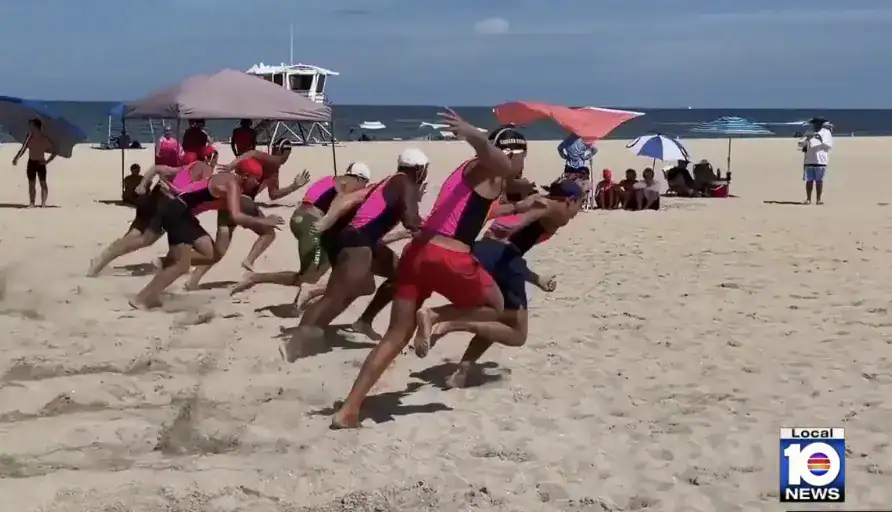
More than 1,200 lifeguards from across the United States recently gathered on Fort Lauderdale Beach for one of the country’s premier professional lifesaving competitions: the 2026 National Lifeguard Championships.
For several days, lifeguards competed in demanding swimming, running, paddling, rowing and rescue-oriented events designed to showcase the strength, endurance and skills associated with professional lifesaving.
But the championships demonstrated something even more important.
They provided the public with an opportunity to see what the American Lifeguard Association (ALA) has emphasized for years: lifeguards are not simply seasonal employees sitting beside a swimming pool or watching the beach from a tower. Lifeguards are trained public-safety professionals and should be recognized as professional first responders.
The South Florida Sun Sentinel reported that more than 1,200 lifeguards from around the country participated in the Fort Lauderdale competition. The newspaper also highlighted how the profession extends well beyond traditional water rescues.
That distinction matters—not only for the men and women working as lifeguards, but for every community that depends upon them.
More Than 1,200 Lifeguards Compete in Fort Lauderdale
The United States Lifesaving Association’s National Lifeguard Championships are held annually and bring together lifeguards from agencies and communities throughout the country.
The 2026 competition transformed Fort Lauderdale Beach into a showcase of professional lifesaving.
Competitors faced events including the 2K beach run, surf ski competition, run-swim-run races, beach flags and Ironman/Ironwoman competitions combining swimming, surfboard, surfboat and beach sprint disciplines.
To a spectator, these events are exciting athletic competitions.
To a professional lifeguard, however, the abilities being demonstrated have a much deeper purpose.
Running speed matters when a lifeguard must reach an emergency hundreds of yards from a tower.
Swimming strength matters when reaching a distressed swimmer through waves or currents.
Endurance matters when a rescue requires sustained physical effort.
Situational awareness matters when conditions change rapidly.
And the ability to remain calm under pressure matters when another person’s life depends upon decisions being made in seconds.
These are not simply athletic abilities.
They are lifesaving abilities.
What Does a Professional Lifeguard Actually Do?
Popular culture has created an incomplete image of lifeguarding.
For generations, lifeguards have often been portrayed as young people spending their summers sitting beside swimming pools or watching the ocean from elevated chairs.
That image dramatically understates the responsibility involved.
Professional lifeguards are responsible for continuously monitoring aquatic environments, identifying dangerous behavior, recognizing changing conditions and intervening before situations become emergencies.
When prevention fails, they may suddenly be required to perform a rescue, administer first aid, begin CPR, use an automated external defibrillator (AED), activate emergency medical services or assist other first responders.
At beaches, their responsibilities can become even broader.
Reporting from the championships noted that lifeguards may encounter drowning emergencies, heart attacks and drug overdoses. Fort Lauderdale lifeguards have even responded beyond the immediate water environment to assist during roadway emergencies.
A lifeguard can therefore move from routine surveillance to a life-threatening emergency almost instantaneously.
That is the reality of professional lifesaving.
Lifeguards Are Professional First Responders
The American Lifeguard Association strongly believes lifeguards deserve greater recognition as professional first responders.
A first responder is fundamentally someone trained and positioned to provide immediate assistance during an emergency until additional emergency resources arrive.
At an aquatic facility or beach, that person is frequently the lifeguard.
When a swimmer becomes unresponsive in the water, the lifeguard does not wait for an ambulance before acting.
The lifeguard enters the water.
The lifeguard performs the rescue.
The lifeguard evaluates the victim.
The lifeguard may begin CPR.
The lifeguard may retrieve and use an AED.
The lifeguard provides critical care during the minutes before additional emergency medical personnel arrive.
Those first few minutes can be decisive.
This is precisely why the way society views lifeguards matters.
Recognizing lifeguards as public-safety professionals reinforces the seriousness of lifeguard training, lifeguard certification, continuing competency and employer-supported training.
It also communicates something important to lifeguards themselves:
Your work matters. Your training matters. Your professionalism matters.
The Most Important Lifeguard Rescue May Be the One That Never Happens
One of the most misunderstood aspects of professional lifeguarding is prevention.
Successful lifeguarding cannot be measured simply by counting dramatic rescues.
In fact, one of the clearest signs of an effective lifeguard operation may be how many emergencies its lifeguards prevent.
Professional lifeguards constantly scan their environments for problems.
They may identify a weak swimmer moving into deeper water.
They may recognize children who have become separated from their parents.
They may stop unsafe diving.
They may warn swimmers about currents.
They may close sections of water because of hazardous conditions.
They may intervene when horseplay creates an unnecessary risk.
They may recognize fatigue before a swimmer realizes he or she is in trouble.
These interventions rarely make headlines.
But they save lives.
The numbers reported from Fort Lauderdale illustrate the enormous scale of this preventive responsibility.
Fort Lauderdale Ocean Rescue reportedly performed approximately 300 water rescues during the previous year while carrying out roughly 65,000 preventive actions.
Think about what those numbers mean.
For every highly visible rescue, lifeguards may conduct hundreds of less dramatic interventions intended to prevent emergencies from developing in the first place.
Prevention is lifesaving.
Lifeguard Training Must Prepare Professionals for Real Emergencies
Recognition as a professional first responder also carries responsibility.
Lifeguard certification cannot simply represent completion of a course. Lifeguards must be able to demonstrate that they can perform the necessary skills when those skills are needed.
The American Lifeguard Association supports a video instructor-led blended learning format that combines structured instruction with the practical competency requirements of the aquatic workplace.
Practical competency is addressed within the aquatics environment through employer-based pre-service evaluations and ongoing in-service procedures established to meet CDC Model Aquatic Health Code (MAHC) requirements and national standards.
That continuing process is important because aquatic facilities differ.
A lifeguard working at an ocean beach may encounter surf, rip currents and changing weather.
A lifeguard at a waterpark may face high-volume attractions and complex evacuation procedures.
A pool lifeguard may need to recognize a submerged swimmer in a crowded environment and initiate a rapid rescue.
Training establishes the foundation. Professional preparedness requires maintaining those abilities.
Why Lifeguard Competitions Matter
The National Lifeguard Championships are valuable because they make otherwise invisible professional skills visible to the public.
Most people never see a lifeguard perform an emergency rescue—and that is a good thing.
But because the public rarely witnesses the most demanding aspects of the profession, it can be easy to underestimate the training and physical abilities required.
Lifeguard competitions change that.
Spectators can watch competitors race through the surf, paddle rescue equipment, demonstrate endurance and transition rapidly among physically demanding events.
The competition also encourages lifeguards to continue developing their abilities.
One competitor explained that the championships provide an opportunity for the public to see skills that beachgoers do not ordinarily witness.
That visibility is important for the entire profession.
Drowning Prevention Remains a National Public-Safety Priority
The championships also arrived during an important period for drowning awareness.
The National Lifeguard Championships take place during Drowning Impact Awareness Month, giving the event significance beyond athletic competition.
Every drowning represents a reminder that access to trained lifeguards, effective supervision, swimming education and strong aquatic safety practices matters.
No single intervention can eliminate drowning.
But professional lifeguards represent one of the most visible layers of protection at supervised aquatic environments.
They educate.
They observe.
They prevent.
They intervene.
And when prevention is no longer possible, they respond.
Professional Recognition Can Help Address the Lifeguard Shortage
Recognizing lifeguards as professionals is also important as communities throughout the United States continue working to recruit and retain qualified lifeguards.
The industry cannot simultaneously describe lifeguards as essential for public safety while treating lifeguarding as insignificant seasonal employment.
Communities that want qualified lifeguards must make the profession attractive.
That means looking seriously at compensation, working conditions, professional development, continuing training and opportunities for advancement.
Employers should also recognize the value of supporting lifeguard training and lifeguard certification rather than placing the entire financial burden of entering the profession on young workers.
When communities invest in lifeguards, they are investing in public safety.
Lifeguarding Can Be the Beginning of a Public-Safety Career
Professional recognition can also change the way young people view lifeguard jobs.
For many teenagers and young adults, lifeguarding represents one of their earliest opportunities to assume genuine responsibility for the safety of other people.
A young lifeguard learns punctuality, teamwork, communication, surveillance, emergency response, physical preparedness and accountability.
They learn that other people depend upon them.
They learn to recognize hazards before those hazards become emergencies.
They learn to make decisions under pressure.
And they learn that training is not merely about passing an examination—it is about being prepared when another human being needs help.
Those experiences can provide an extraordinary foundation for future careers in emergency medical services, firefighting, law enforcement, healthcare, aquatics management, recreation and other public-safety professions.
Lifeguarding deserves to be presented accordingly.
The American Lifeguard Association’s Message: Elevate the Profession
The American Lifeguard Association believes the future of aquatic safety requires elevating the professional standing of lifeguards.
That does not happen through terminology alone.
It requires strong training.
It requires documented competency.
It requires employer involvement.
It requires continuing in-service training.
It requires appropriate staffing.
It requires professional working conditions.
And it requires communities to recognize the enormous responsibility placed upon the individuals protecting their swimming pools, beaches and aquatic facilities.
The National Lifeguard Championships demonstrate what professional lifesaving looks like at an elite competitive level.
But thousands of lifeguards demonstrate that professionalism every day without crowds, medals or television cameras.
They arrive at swimming pools before opening.
They climb into towers along America’s beaches.
They inspect equipment.
They scan the water.
They warn swimmers.
They administer first aid.
They practice rescue skills.
And they remain ready for the moment everyone hopes never comes.
A Profession Worth Recognizing
The more than 1,200 lifeguards who gathered in Fort Lauderdale represented communities from across the United States. Their competition showcased remarkable athletic ability, but it also delivered a larger message about the profession.
Lifeguarding is serious work.
The public entrusts lifeguards with something extraordinarily valuable: human life.
The American Lifeguard Association congratulates the competitors who participated in the 2026 National Lifeguard Championships and the thousands of professional lifeguards protecting aquatic environments throughout the United States.
The championships remind us that behind every lifeguard tower, rescue tube and whistle is a trained individual expected to recognize danger and respond when seconds matter.
Police officers are first responders.
Firefighters are first responders.
Emergency medical personnel are first responders.
And at America’s beaches, swimming pools, waterparks and aquatic facilities, lifeguards are often the first trained professionals to recognize an emergency, reach the victim and begin lifesaving care.
That deserves greater public recognition.
It deserves greater professional recognition.
And it deserves continued investment in the recruitment, training and development of America’s lifeguards.
Lifeguards do much more than watch the water. They prevent emergencies, respond to crises and save lives.
Lifeguards are professional first responders.
Frequently Asked Questions About Professional Lifeguards
What are the National Lifeguard Championships?
The National Lifeguard Championships are competitive lifesaving events bringing together professional lifeguards from across the United States. Events test abilities including swimming, running, paddling, rowing, endurance and other skills associated with professional lifesaving.
Are lifeguards considered first responders?
The American Lifeguard Association believes lifeguards should be recognized as professional first responders because they are frequently the first trained personnel positioned to recognize and respond to emergencies in aquatic environments. Lifeguards may perform water rescues, provide first aid, administer CPR and use AEDs while additional emergency medical resources are being activated.
Why is lifeguard training important?
Lifeguard training prepares individuals to recognize aquatic emergencies, prevent injuries and respond when an emergency occurs. Effective professional preparation also requires practical competency within the aquatic environment, employer-based pre-service evaluation and ongoing in-service training.
What skills does a professional lifeguard need?
Professional lifeguards require strong surveillance and communication skills, swimming ability, rescue competency, physical endurance, first aid and CPR/AED knowledge, sound judgment and the ability to remain calm during emergencies.
Why are preventive actions important in lifeguarding?
Prevention is one of a lifeguard’s most important responsibilities. By identifying unsafe behavior, dangerous conditions and swimmers who may be developing difficulty, lifeguards can intervene before an incident becomes a rescue or medical emergency.
How can someone become a certified lifeguard?
Individuals interested in becoming lifeguards should complete a nationally recognized lifeguard certification and training such as offered by the American Lifeguard Association, develop the required rescue and emergency-care competencies, and successfully complete the practical requirements established for the aquatic environment in which they will work.