Artificial intelligence could become a powerful second set of eyes for professional lifeguards—helping identify potential emergencies faster while keeping trained lifeguards at the center of aquatic safety and drowning prevention.
The American Lifeguard Association® believes emerging AI drowning detection technology has the potential to add an important layer of protection at swimming pools, aquatic facilities, waterparks, resorts, and other supervised aquatic environments.
Through its American Lifeguard™ training and aquatic safety initiatives, the Association supports exploring reliable new technologies that can help trained lifeguards recognize potential emergencies faster and strengthen drowning-prevention efforts.
For decades, lifeguards have relied on professional training, active surveillance, sound judgment, and rapid emergency response to protect swimmers. Those fundamentals remain essential.
But advances in artificial intelligence, computer vision, underwater cameras, and real-time pool surveillance technology are creating opportunities to give lifeguards something they have never had before: a technological second set of eyes continuously helping watch the water.
The American Lifeguard Association believes this technology should be explored not as a replacement for professional lifeguards, but as another tool that could help make trained lifeguards even more effective.
The Challenge of Constant Lifeguard Surveillance
Effective lifeguard surveillance requires extraordinary concentration.
At a crowded swimming pool, dozens of movements can occur simultaneously. Children may repeatedly disappear beneath the surface while playing. Swimmers cross one another’s paths. Sunlight and reflections create glare. Lane ropes, diving boards, play structures, water features, and other swimmers can temporarily obstruct a lifeguard’s view.
A person experiencing difficulty in the water may also look very different from the dramatic drowning scenes portrayed in movies and television.
An aquatic emergency can develop quickly and may not involve obvious shouting, splashing, or waving for help.
That makes early recognition critically important.
Professional lifeguards are trained to continually scan their assigned surveillance zones and recognize signs of distress. However, emerging technology could provide another layer of observation alongside that human surveillance.
How Could AI Drowning Detection Work?
Modern AI-powered drowning detection systems can combine cameras, computer vision, and software designed to analyze swimmer movement.
Rather than simply recording video, these systems may continuously evaluate activity within an aquatic environment and identify patterns that could warrant a lifeguard’s attention.
Depending on the technology and how it is designed, an AI-assisted system may potentially help identify situations involving:
- prolonged submersion;
- an unexpected lack of movement;
- unusual body positioning;
- sudden changes in swimming behavior;
- movement inconsistent with surrounding swimmers; or
- other patterns that may indicate a swimmer requires attention.
When the technology identifies something unusual, an alert can direct lifeguard personnel to immediately evaluate the situation.
That distinction is extremely important.
Artificial intelligence should not make the rescue decision. A trained lifeguard should.
The role of AI should be to help draw a lifeguard’s attention to something that may require immediate investigation.
A Second Set of Eyes for Professional Lifeguards
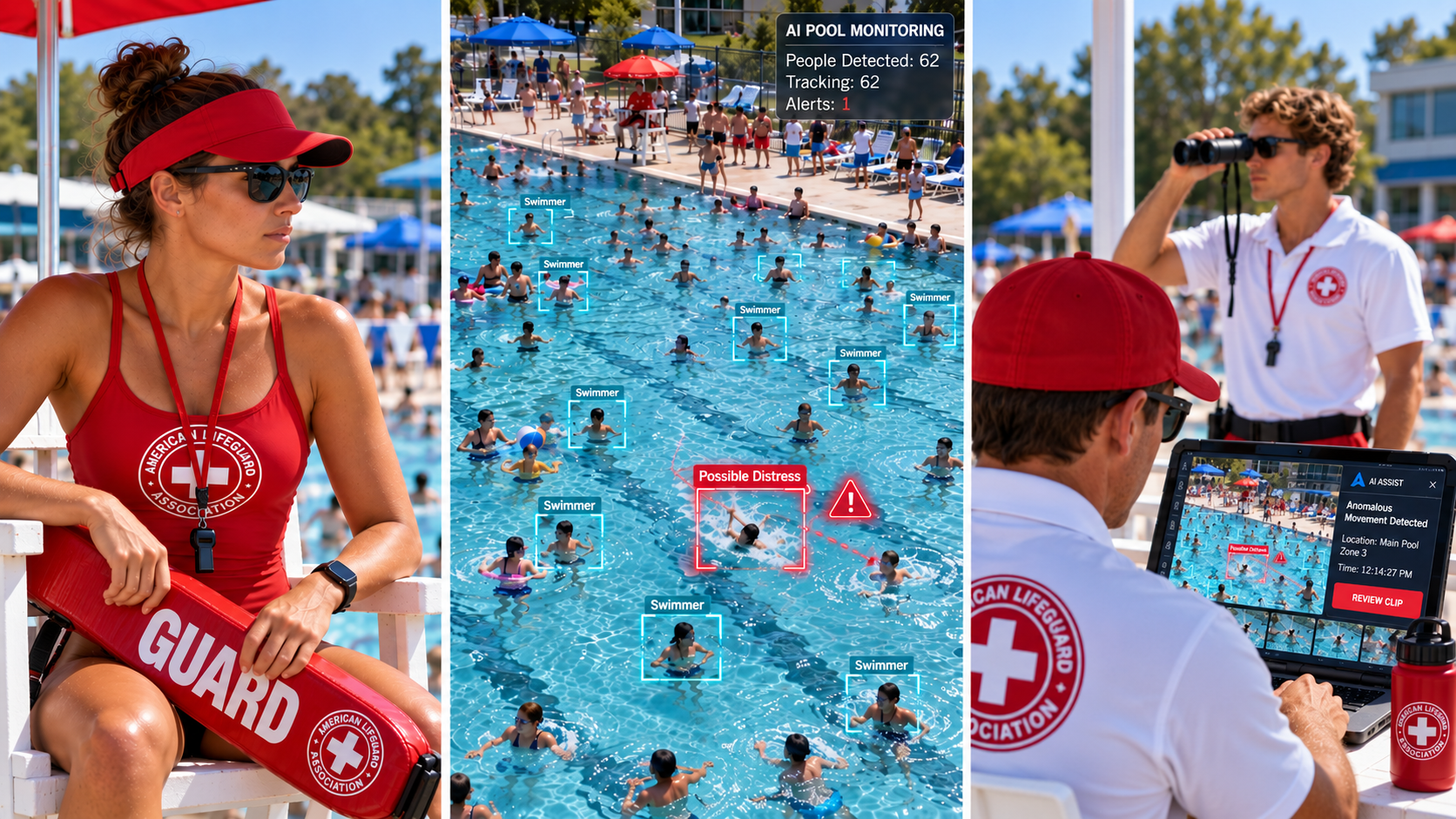
Imagine a busy aquatic facility where lifeguards are actively scanning the water while multiple cameras simultaneously observe different sections of the pool.
The lifeguards remain responsible for surveillance.
But behind the scenes, artificial intelligence is continuously analyzing the camera feeds.
If the system detects an unusual pattern in one portion of the pool, it could immediately alert the lifeguard.
The lifeguard then determines whether an emergency exists and what action is necessary.
This creates a potentially powerful combination:
Human judgment + professional lifeguard training + continuous technological support.
The computer assists with observation.
The lifeguard remains the decision-maker and responder.
AI Could Help Lifeguards With Blind Spots
One particularly promising application of AI in swimming pool safety involves visibility.
Even a well-designed lifeguard station cannot necessarily provide an equally clear view of every portion of a pool at every second.
Sunlight and glare can make surface observation difficult. Architectural features may obstruct sight lines. Groups of swimmers can temporarily hide another swimmer from view. Diving boards, water features, lane ropes, and other equipment can create additional visual challenges.
Technology could potentially provide perspectives the human eye cannot continuously maintain.
Strategically positioned cameras may observe several portions of an aquatic facility simultaneously, while underwater cameras could provide additional perspectives beneath the surface.
AI could then analyze those feeds and alert trained personnel when something unusual is detected.
The objective is not to rely on one viewpoint.
It is to create multiple layers of surveillance.
Could AI Help Reduce the Impact of Lifeguard Fatigue?
Lifeguarding is physically demanding, but it is also mentally demanding.
Maintaining continuous attention while watching repetitive activity for long periods requires significant concentration.
Human attention can fluctuate, particularly during extended periods of surveillance or extremely busy recreational swimming.
Technology does not experience fatigue in the same way.
A properly designed AI pool monitoring system could continuously analyze the same surveillance zones while professional lifeguards maintain primary responsibility for swimmer observation and emergency response.
The two can complement each other.
The lifeguard provides judgment, context, experience, communication, decision-making, and physical response.
Technology provides continuous data analysis.
AI Should Support Lifeguards—Not Replace Them
The American Lifeguard Association believes one principle should remain central as this technology develops:
AI-assisted drowning detection should strengthen professional lifeguard protection—not become an excuse to eliminate lifeguards or inadequately staff aquatic facilities.
Artificial intelligence cannot jump into a swimming pool.
It cannot physically remove a distressed swimmer from the water.
It cannot independently perform a water rescue, provide emergency care, administer CPR, use an AED, manage an emergency scene, reassure frightened family members, or coordinate effectively with emergency medical personnel.
Those responsibilities still require trained people.
Technology also has limitations.
Cameras can become obstructed. Software can generate false alerts. Electrical systems and networks can experience interruptions. Algorithms may encounter situations they were not designed to recognize.
Most importantly, recognizing a possible emergency is only one component of drowning prevention and emergency response.
Someone still has to respond.
That is why the American Lifeguard Association views AI as a potential supplemental aquatic safety system, not a substitute for professional lifeguards.
Redundancy Could Make Aquatic Facilities Safer
Safety-critical industries frequently rely on redundancy.
Aquatic safety can benefit from the same philosophy.
If a lifeguard identifies an emergency first, the rescue response begins.
If technology identifies unusual behavior first and alerts the lifeguard, the lifeguard can immediately investigate.
Either way, trained personnel remain responsible for determining what is occurring and taking appropriate action.
This creates an additional opportunity to identify a developing emergency sooner.
And in an aquatic emergency, seconds can matter.
AI Could Change More Than Drowning Detection
The potential benefits of artificial intelligence in aquatic facilities may eventually extend beyond immediate drowning detection.
Future aquatic safety technology could potentially help facilities analyze surveillance zones, identify recurring blind spots, evaluate incident patterns, review emergency responses, and improve facility-specific safety procedures.
Over time, information generated by these systems could potentially contribute to improvements in:
- lifeguard positioning;
- surveillance-zone design;
- lifeguard rotations;
- aquatic facility design;
- emergency-action planning;
- staff training;
- incident review; and
- broader drowning-prevention strategies.
Artificial intelligence could therefore become more than an emergency-alert technology.
It may eventually become another tool aquatic managers use to understand and improve the safety of their facilities.
AI Technology Must Be Evaluated Carefully
The promise of artificial intelligence does not mean every system should automatically be trusted.
Aquatic environments are complicated.
Children intentionally remain underwater while playing. Competitive swimmers may stay submerged during training. People dive, splash, float, exercise, use toys, and move unpredictably.
Lighting conditions change.
Water clarity changes.
Pools become crowded.
Reflections move across the surface.
Every one of those factors can make automated drowning detection more difficult.
Before an AI system becomes an integral component of aquatic safety operations, facilities should consider issues including accuracy, reliability, false alerts, privacy, cybersecurity, camera placement, system maintenance, staff training, emergency procedures, and system limitations.
The technology must support the safety system—not dictate it.
Real-World Testing Will Be Critical
Developers of AI drowning prevention technology also need access to real-world aquatic environments.
A system that performs well under controlled conditions may face very different challenges at a crowded municipal pool, hotel, waterpark, resort, fitness center, or recreational facility.
Real-world swimming environments include:
- splashing children;
- diving;
- swim lessons;
- competitive swimming;
- water exercise;
- pool toys;
- changing lighting;
- varying water depths;
- crowded recreational swimming; and
- swimmers with dramatically different abilities.
For AI-assisted drowning detection to become a meaningful safety tool, technology must function reliably under realistic operating conditions.
That creates an opportunity for cooperation among technology developers, aquatic facilities, lifeguard professionals, researchers, manufacturers, and drowning-prevention organizations.
American Lifeguard Association Wants to Help Move This Technology Forward
The American Lifeguard Association is interested in working with companies, researchers, aquatic facilities, engineers, manufacturers, safety professionals, and other organizations developing credible AI drowning detection, computer vision, smart pool monitoring, and advanced aquatic surveillance technologies.
The objective is straightforward:
Give trained lifeguards better tools to protect swimmers.
The Association believes collaboration between aquatic safety professionals and technology developers could be particularly valuable.
Engineers understand artificial intelligence.
Lifeguards understand the realities of surveillance and emergency response.
Aquatic facility operators understand how pools function under everyday conditions.
Bringing those groups together could help ensure new technology solves real aquatic safety problems rather than simply introducing technology into an environment without understanding how it will actually be used.
Could AI Become Standard Equipment at Swimming Pools?
The aquatic industry has adopted many safety technologies over time.
Communication systems have improved.
Rescue equipment has improved.
AED availability has expanded.
Emergency-response procedures have evolved.
Artificial intelligence could represent another significant development.
It is possible to envision a future aquatic facility where professional lifeguards actively scan the water while strategically positioned cameras provide additional perspectives and AI continuously evaluates those images for possible signs of distress.
If either the lifeguard or the technology notices something unusual, trained personnel can investigate immediately.
That additional layer of protection could prove extremely valuable.
The Lifeguard of the Future May Have More Powerful Tools
Technology works best in public safety when it strengthens trained professionals rather than attempting to eliminate them.
AEDs did not eliminate rescuers.
Advanced communications did not eliminate emergency responders.
Improved rescue equipment did not eliminate lifeguards.
Those technologies gave trained professionals better tools.
Artificial intelligence may represent the next step.
The lifeguard of the future may still sit in a lifeguard chair, continuously scanning swimmers and maintaining responsibility for their surveillance zone.
But that lifeguard may also have technology quietly working alongside them—watching additional camera angles, analyzing underwater movement, identifying unusual patterns, and providing an immediate alert when something deserves a closer look.
The Future Is AI Working Alongside Lifeguards
The question facing the aquatic safety community should not simply be:
Can artificial intelligence replace lifeguards?
A far more useful question is:
Can artificial intelligence help trained lifeguards recognize an emergency sooner than they otherwise might?
If reliable technology can help accomplish that while maintaining professional lifeguards as the primary decision-makers and emergency responders, the American Lifeguard Association believes the technology deserves serious consideration and continued development.
The future of drowning prevention may combine something humans do exceptionally well—judgment, experience, communication, compassion, and emergency response—with something computers can do exceptionally well: continuously analyze enormous amounts of information.
Human judgment. Professional lifeguard training. Continuous technological support.
Working together, they may create safer aquatic environments.
And if emerging technology can help a trained lifeguard recognize an emergency even a few seconds sooner, those few seconds could make all the difference.
Frequently Asked Questions
Can AI detect someone drowning?
AI-assisted systems can analyze camera feeds for movement patterns or behaviors that may indicate a swimmer is experiencing difficulty. The technology can then alert trained personnel to investigate.
Can artificial intelligence replace lifeguards?
AI should be considered a supplemental surveillance tool rather than a replacement for trained lifeguards. Lifeguards provide human judgment, rescue capability, emergency care, and real-time decision-making that technology cannot replace.
How can AI help lifeguards?
AI can continuously analyze camera feeds and potentially draw attention to unusual swimmer behavior, prolonged submersion, limited movement, or areas that may be difficult for a lifeguard to observe continuously.
Can underwater cameras improve pool safety?
Underwater cameras can provide additional perspectives that may complement traditional above-water surveillance. When combined with computer vision, they may help identify situations requiring a lifeguard’s attention.
What is the future of AI in lifeguarding?
AI may increasingly support professional lifeguards through drowning detection, surveillance assistance, incident analysis, blind-spot monitoring, and other aquatic safety applications. Human lifeguards should remain responsible for evaluating emergencies and conducting rescues.