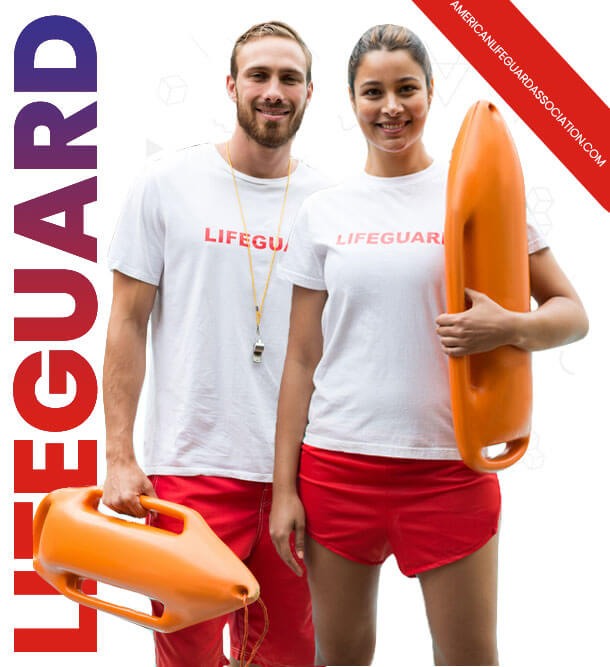
Becoming a certified lifeguard is one of the most meaningful ways to serve your community, protect swimmers, and build a strong foundation for employment in aquatics, recreation, hospitality, camps, schools, waterparks, and public pools. The American Lifeguard Association offers a national lifeguard certification pathway designed to help candidates learn essential lifesaving skills through a video instructor-led blended learning format. The U.S. Department of Labor’s Wage and Hour Division Field Operations Handbook identifies the American Lifeguard Association as one of the organizations offering lifeguard certification programs similar to the American Red Cross for purposes of 29 CFR § 570.34(l). (American Lifeguard Association)
What Is ALA Lifeguard Certification?
ALA lifeguard certification is a training program that prepares entry-level lifeguards to help prevent, recognize, and respond to aquatic emergencies. The program includes lifeguarding, CPR/AED, and First Aid training, with instruction covering rescue techniques, emergency response, injury prevention, spinal injury management, and professional responsibilities. ALA describes its program as a blended course that allows participants to complete the educational portion at their own pace through video instruction and online study materials. (American Lifeguard Association)
It is important to understand that ALA does not offer an online-only lifeguard certification. The proper description is video instructor-led blended learning. The educational portion is completed through video-based instruction and online materials, while practical competency is addressed within the aquatics environment through employer-based pre-service evaluations and ongoing in-service procedures established to meet CDC Model Aquatic Health Code requirements and national standards set by the CDC, not ALA-created requirements. The 2024 MAHC includes pre-service training plans, in-service training plans, pre-service evaluations, skills proficiency demonstrations, and documentation requirements for aquatic facilities.
Step 1: Make Sure You Meet the Basic Requirements
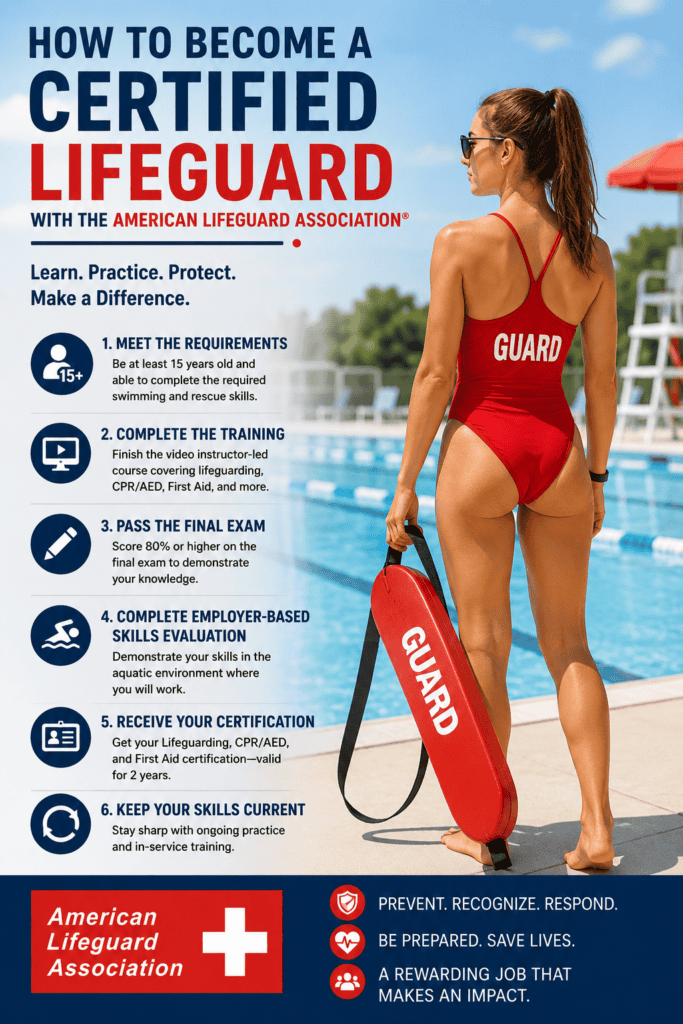
Before beginning lifeguard training, candidates should make sure they are physically prepared for the responsibilities of the job. ALA’s listed prerequisites include being at least 15 years old and being able to complete required swimming and rescue skill components. These include a swim-tread-swim sequence, treading water using only the legs, and completing a timed brick retrieval skill involving a 10-pound object. (AmericanLifeguardUSA)
Because lifeguarding is a hands-on safety position, candidates should be comfortable in the water, able to swim with control, and willing to practice rescue skills repeatedly. A strong lifeguard is not only a strong swimmer but also someone who can remain alert, follow procedures, communicate clearly, and respond quickly under pressure.
Step 2: Choose the Right ALA Course
The next step is selecting the ALA course that matches your needs. First-time candidates generally take the full lifeguard certification course. Returning lifeguards with a current or recently expired certification may qualify for lifeguard recertification. Candidates working in shallower aquatic environments may consider shallow-water lifeguard training, while those working in deeper pools, lakes, waterparks, or more demanding aquatic settings may need deep-water lifeguard certification.
Selecting the correct course matters because employers assign lifeguards based on the type of aquatic environment, water depth, facility layout, and required rescue skills. A hotel pool, community pool, school pool, waterpark, lakefront, or beach may each have different operational needs.
Step 3: Complete the Video Instructor-Led Training
Once registered, candidates review the ALA training videos, online lifeguard manual, and educational materials. These materials are designed to teach the knowledge needed to prevent and respond to aquatic emergencies, including scanning, victim recognition, water rescue techniques, CPR/AED, First Aid, emergency action plans, and care for sudden illness or injury.
The video instructor-led format is especially useful for students, seasonal workers, working adults, and employers who need flexible training options. Candidates can review materials at their own pace and return to key topics as needed. However, flexibility does not reduce the importance of practical skill readiness. Lifeguards must be able to perform the skills shown in the training and continue practicing both in and out of the water.
Step 4: Pass the Final Exam
After reviewing the required training materials, candidates complete the final written exam. ALA states that successful completion of the final exam requires a score of 80% or higher. Candidates who do not pass may retake the exam at no additional cost, and successful candidates receive confirmation of completion. (AmericanLifeguardUSA)
The written exam helps confirm that the candidate understands lifeguard responsibilities, emergency procedures, CPR/AED concepts, First Aid response, and other essential safety topics. This knowledge is then supported by facility-specific practical competency evaluation and ongoing in-service training once the lifeguard is working or being prepared for assignment.
Step 5: Complete Employer-Based Practical Evaluation
A lifeguard’s certification is only one part of professional readiness. Before being assigned to active duty, lifeguards must be evaluated within the actual aquatic environment where they will work. This is why employer-based pre-service evaluation is so important.
The CDC Model Aquatic Health Code recognizes the importance of facility-specific training and documentation. The 2024 MAHC states that aquatic facility safety plans include pre-service and in-service training plans, and that staffing plans designate persons responsible for conducting pre-service evaluations and in-service training. The MAHC also requires qualified lifeguards to demonstrate facility-specific skills, including emergency action plan execution, zone recognition, victim recognition, reaching assigned surveillance zones, rescue skills, CPR/AED, First Aid, and other emergency response procedures.
Step 6: Verify Your Certification
After successful completion, candidates receive certification in Lifeguarding, CPR/AED, and First Aid. ALA states that certification records are placed in the National Verification System, allowing employers and health department officials to view validated certification records. A waterproof wallet-size certification card is also mailed to the candidate. (AmericanLifeguardUSA)
This verification process is helpful when applying for lifeguard jobs, responding to employer questions, or providing documentation during inspections. Candidates should keep both digital and printed copies of their certification and provide them to employers when requested.
Step 7: Keep Your Skills Current
Lifeguarding is not a one-time learning experience. Skills must be practiced regularly. ALA certifications are generally valid for two years, and lifeguards must renew through recertification before expiration. (AmericanLifeguardUSA)
Employers also play a major role in maintaining lifeguard readiness. The MAHC includes ongoing in-service training and documentation expectations, including periodic training, records of attendees, training content, dates, trainers, maintenance of certifications, and demonstration of test-ready skills.
Frequently Asked Questions
1. Can I become a certified lifeguard with ALA online?
ALA uses a video instructor-led blended learning format. The educational portion may be completed through online videos, materials, and an exam, but lifeguard certification is not simply “online-only.” Practical competency must be addressed through employer-based pre-service evaluation and ongoing in-service training in the aquatics environment.
2. What does the ALA lifeguard course include?
The course includes lifeguarding, CPR/AED, First Aid, rescue skills, emergency response, prevention, victim recognition, and care for injuries or sudden illnesses. Candidates must understand the material and be able to perform the required skills.
3. How old do you need to be to become a lifeguard?
ALA lists the Lifeguarding course requirement as at least 15 years of age, along with completion of required swimming and rescue skill components. Some waterfront or beach positions may have higher age requirements depending on employer, state, local, or facility rules. (AmericanLifeguardUSA)
4. Is ALA lifeguard certification nationally recognized?
The U.S. Department of Labor’s Wage and Hour Division Field Operations Handbook identifies the American Lifeguard Association as offering lifeguard certification programs similar to the American Red Cross for purposes of 29 CFR § 570.34(l). (DOL)
5. How long is ALA lifeguard certification valid?
ALA states that participants who complete the lifeguarding course receive certification in Lifeguarding, First Aid, and CPR/AED valid for two years. Lifeguards should also follow employer, state, local, and facility requirements for ongoing in-service training and renewal. (AmericanLifeguardUSA)
6. Do employers still need to evaluate my skills?
Yes. Employers are required to conduct documented pre-service evaluations and ongoing in-service training so lifeguards can demonstrate facility-specific competency. This is part of national aquatic safety expectations under the CDC Model Aquatic Health Code.
7. What jobs can I apply for after becoming certified?
Certified lifeguards may apply for positions at pools, waterparks, schools, camps, hotels, resorts, fitness centers, community centers, lakes, beaches and other aquatic facilities, depending on the type of certification held and the employer’s requirements.
8. How do I get started?
Register for the appropriate ALA lifeguard certification course, complete the video instructor-led training materials, pass the final exam, print and save your certification, and work with your employer to complete the required facility-specific practical evaluation and in-service training.