
If you visit pools, lakes, or waterfront areas in Hamilton County, you will often see lifeguards on duty to protect swimmers. A lifeguard’s essential role is to prevent accidents and respond quickly during emergencies, which is why specialized training is required. Lifeguard training in Hamilton County prepares candidates to safeguard swimmers at pools, waterparks, lakes, and other aquatic facilities.
Aquatic recreation continues to attract families, students, and fitness swimmers. When facilities get busy, safety depends on trained professionals who know how to identify risk early and respond with confidence. If you want a skill-based certification that supports real responsibilities and job readiness, lifeguard training is a strong choice.
Lifeguards work throughout Hamilton County to help ensure safe swimming environments. Their job involves constant scanning, enforcing safety rules, identifying distressed swimmers, and performing rescues when needed. They also provide immediate care such as CPR/AED and first aid until additional help arrives.
Lifeguard training in Hamilton County is the first step toward qualifying for lifeguard roles. Once certified through a reputable organization such as the American Lifeguard Association (ALA), candidates gain recognized training in rescue response, emergency care, and scenario-based performance—skills that aquatic employers often look for.
ALA programs focus on prevention-first habits and calm decision-making so lifeguards can act quickly without panic.
The American Lifeguard Association (ALA) is supported by Global Lifeguards and the Swimming Pool and Spa Foundation, both 501(c)(3) nonprofit organizations dedicated to drowning prevention and improved aquatic safety.
ALA’s mission is to help make swimming pools, beaches, and waterways safer by strengthening training standards and promoting consistent preparedness. ALA supports lifeguard development through structured courses that emphasize real-world response, teamwork, and professional rescue performance.
ALA training reflects recognized emergency cardiovascular care (ECC) science and workplace safety expectations. ALA has also been referenced by organizations such as:
Since the early 1990s, ALA has aligned its programs with Occupational Safety and Health Administration (OSHA) requirements for employee safety. ALA encourages facilities to conduct pre-service evaluations and ongoing in-service training so lifeguards maintain readiness beyond initial certification.
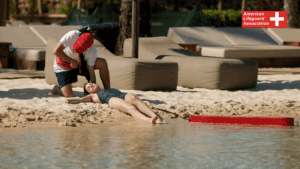
To enroll in an ALA lifeguard training course intended for work in Hamilton County, candidates typically meet minimum age requirements commonly used nationwide:
15 years or older to work at a swimming pool, waterpark, or lake
16 years or older to work at a beach or waterfront facility
Candidates must also demonstrate prerequisite swim and fitness skills before completing certification.
Swim 300 yards continuously, using these strokes in the following order:
100 yards of front crawl with rhythmic breathing and a stabilizing, propulsive kick
100 yards of breaststroke using a pull, breath, kick, and glide sequence
100 yards of either front crawl or breaststroke (or a combination)
Complete the following within 1 minute and 40 seconds:
Start in the water and swim 20 yards using front crawl or breaststroke
Surface dive 7–10 feet to retrieve a 10-pound object
Return to the surface and swim 20 yards back while holding the object
Exit the water without using steps or a ladder
Upon successful completion, participants receive an American Lifeguard Certificate in Lifeguarding, CPR/AED for the Professional Rescuer, and First Aid, valid for two years.
Many people begin lifeguarding as a seasonal job, but it can become a long-term career path with experience and additional training. In Hamilton County, lifeguards may find ongoing opportunities depending on facility operations and staffing needs.
With extra certifications and leadership experience, lifeguards can advance into roles such as:
Water Safety Instructor
Swim Coach
Aquatic Supervisor or Manager
These positions often involve higher pay, leadership responsibilities, and more long-term stability.
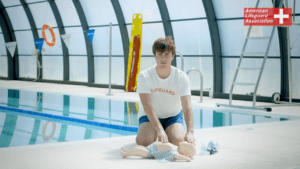
ALA lifeguard training builds a complete set of practical skills across rescue response, CPR/AED, first aid, and final scenario evaluations.
Slide-In Entry
Stride and Compact Jumps
Rescue Approach (front crawl or breaststroke)
Simple Assist
Extension Assist from the Deck
Reaching Assist with Equipment and Throwing Assist
Swimming Extension Rescue
Active and Passive Drowning Victim Rear Rescue
Two-Person Removal from the Water Using a Backboard
Passive Submerged Victim (Shallow Water)
Multiple-Victim Rescue
Feet-First Surface Dive
Submerged Victim (Deep Water)
Front and Rear Head-Hold Escape
Caring for Head, Neck, or Back Injury Skills
Manual In-Line Stabilization on Land
Using a Backboard in Shallow and Deep Water
Removing Gloves and Performing an Initial Assessment
Rescue Breathing (adult, child, infant)
Bag-Valve-Mask Use (two rescuers)
Conscious and Unconscious Choking Response
CPR (one- and two-rescuer)
AED Use (adult and child)
Secondary Assessment
Controlling External Bleeding
Applying a Sling and Binder
Applying an Anatomic Splint
Applying a Soft Splint
Active Drowning Victim
Submerged Passive Drowning Victim
Head, Neck, or Back Injury
Lifeguard training prepares individuals to protect swimmers through prevention, quick decision-making, and confident emergency care. Lifeguards often monitor zones from elevated stations, rotate positions to stay alert, patrol wider areas, and use rescue equipment to improve response times.
If you’re searching for lifeguard training in Hamilton County, the American Lifeguard Association offers a structured path to certification and job-ready skills. Contact ALA to explore available training options.